Microsoft is moving all of its Hotmail users to Outlook.com by this
summer. Here's what the hundreds of millions still using Hotmail need to
know about the transition.
Microsoft announced earlier this week that it is closing Hotmail and moving the "hundreds of millions" still using it to Outlook.com by this summer.
The move isn't unexpected, but perhaps more sudden than some
anticipated. Hotmail users, once they move (or are moved) will get
Outlook.com's clean, Metro-Style interface for their mail -- and
ultimately, calendars. (For a walk-through of the UI changes Hotmail
users will see, check out this Microsoft FAQ.)
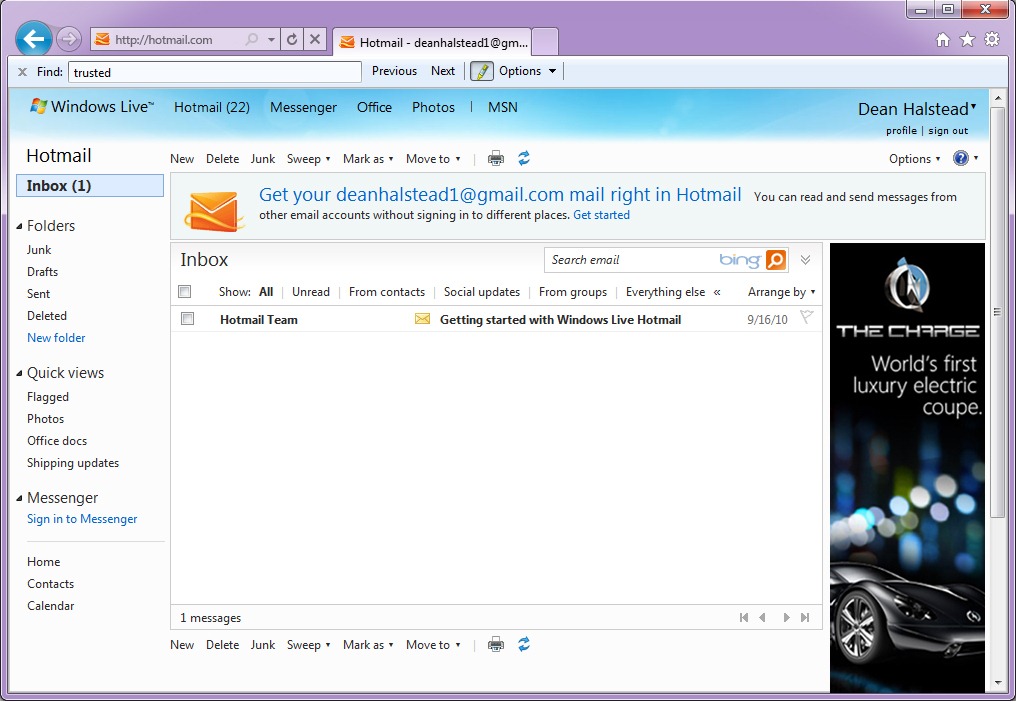
Given that many of the new features in Outlook.com -- Microsoft's new Web-mail service that is no longer in "preview," as of this week -- are already part of Hotmail, the Outlook.com experience (beyond the UI itself) shouldn't be too jarringly different.
Microsoft provided guidance last summer
for those who wanted to proactively make the Hotmail-to-Outlook.com
move. There's not much required on users' parts to make this happen. But
some users still have questions. And different folks around the Web
have answers.
Q: How much warning do users get before Microsoft move an existing Hotmail account to Outlook.com?
A: There will be several e-mails first prompting people to upgrade on their own.
Q: If I move my Hotmail account to an Outlook.com account, can I change my mind and go back?
A: At this point, no. (When Outlook.com was still in "preview," Microsoft did allow this.)
Q: What happens to all my stored Hotmail once I am moved off Hotmail to Outlook.com?
A: Everything moves over. If you click the upgrade
button it takes maybe a few seconds, but all your existing messages
auto-populate and carry over.
Q: Which browsers support Outlook.com?
A: Outlook.com is optimized for
Internet Explorer 8, 9 and 10; Google Chrome 17 and higher; Firefox 10
and higher; Safari 5.1 on Mac. It also works relatively well on IE 7,
Google Chrome 16 and 5; Firefox 9 and 5; Safari 5.1 on Windows and
Safari 5 on Windows and Mac. It doesn't work at all on IE 6 and older;
Google Chrome 4 and older; Firefox 4 and older; and Safari 4.X and
older.
Q: What happens if my Microsoft ID/Windows Live ID is tied to Hotmail? Do I have to get a new one and change my accounts?
A: No. If you use an @hotmail.com, @msn.com or @live.com e-mail address as your Microsoft account, you can keep it, even after Hotmail is shuttered.
"Think of this the same way as you would changing your mobile phone
carrier. You are simply moving to a better service, but your 'number'
(in this case your Microsoft account and email address) stays the same,"
a Microsoft spokesperson explained.
Q: I already created a separate, new Outlook.com account. So
once my existing Hotmail account is moved to Outlook.com, what happens?
Will my two Outlook.com accounts be merged?
A: There is no way to actually "merge" these accounts.
But you can connect these two accounts and then toggle back and forth
by linking them. To do this, go to account settings and select the
permissions tab. Click on "manage linked accounts."
Q: Users are being allowed to keep their Hotmail addresses if
they want. Wasn’t a big part of creating Outlook.com a plan to get rid
of the tired/tainted Hotmail brand?
A: "The simple fact is that many people are attached
to their email address. We do expect a certain number to want a new
Outlook.com address (which is great); others will want to keep their
Hotmail address. Either is fine since they will all get to use the new
service," a Microsoft spokesperson confirmed.
Q: When will Microsoft update the calendar in Outlook.com so that it is Metro-Style, instead of Hotmail-Style?
A: Microsoft officials aren't saying anything other than what they've said since summer 2012, which is "soon."
Q: When will Outlook.com be integrated with Skype?
A: Also "soon." No further word from the Softies on the timing.
Read this full story here: http://www.zdnet.com/microsofts-hotmail-phase-out-whats-a-user-to-do-7000011688/
For more information on anything you have read please contact the IT Support Glasgow experts at Click Networks email info@clicknetworks.co.uk or visit our website http://www.clicknetworks.co.uk
Click Networks is an IT Support Company based in Glasgow Scotland.
Monday, 25 February 2013
Tuesday, 19 February 2013
Why are online companies moving into TV??
Figures are not out yet for how many people
signed up to Netflix in the past week, drawn in by Kevin Spacey's House
of Cards drama series, but it marked a significant shift in where we'll
find 'must see' TV in the future.
"I think it will certainly be a very exciting year for online content," notes Director of Amazon Studios, Roy Price.
Price is responsible for making original TV content for Amazon's pay subscription services - Amazon Prime in the US, and Lovefilm in the UK.
"The line between online and 'other' probably starts to become a bit blurred," he admits, adding that Amazon Studios currently has six shows being piloted.
"Right now we have a range," says Price, "we have kids, mostly focusing on pre-school educational content.
"And then on the adult side I would say it is all right now, half hour and comedic in nature."
Microsoft's plans aren't quite as fully formed yet but creating a TV studio in Los Angeles this year is the main objective with original content from all genres being considered.
The programming would sit on Microsoft's Xbox live and use the interactivity that service can offer.
And then there's YouTube, owned by Google.
The online site recently launched its original channels initiative with 20 new channels coming from the UK.
"YouTube gave an advance on future advertising revenue to a few channels," explains Google's Zayna Aston, "to basically help kick start the production of original content on the platform."
'Food Tube'
One of those channels is Jamie Oliver's Food Tube which already has 143,000 subscribers, 13 million video views, and it only launched on 21 January 2013.
Whereas Amazon, Microsoft and Netflix own their content, YouTube does not, choosing to concentrate on its proven technology platform instead.
So should traditional TV networks feel threatened by their online competition?
"I think it will be interesting to see how everything evolves with respect to all the different channels and sources of content," muses Amazon's Roy Price.
"And for now all we can do is create the best service we can and certainly to date we co-exist quite amicably with all of our channel and other programming partners."
Traditional TV channels are not being complacent, with audiences increasingly using on demand services such as itv player, 4OD and the BBC's iPlayer.
Victoria Jaye oversees all of the BBC's TV content online and aside from recent statistics that revealed a 177% year-on-year increase in the use of mobiles and tablets to watch shows on iPlayer, there's been another shift.
Jaye says in 2008, 25% of people coming to iPlayer were just browsing.
That's now risen to 42% marking "a change in iPlayer from this catch-up product or utility to a sort of discovery or entertainment experience".
"I think it's really fantastic," reflects Jaye, "that we are seeing the on demand market become creatively competitive with people like Netflix originating content.
"We really want a creative competitive on demand market so for us this is, 'Bring it on!' We're excited."
Please read the full article here: BBC NEWS
For more information on anything you have read, please contact the IT Support Experts at Click Networks in Glasgow. Visit our website: http://www.clicknetworks.co.uk/
Labels:
click networks,
it support glasgow,
netflix,
on demand,
online tv,
streaming tv shows,
web tv
Location:
Glasgow, Glasgow City G2 2TJ, UK
Monday, 11 February 2013
The end of CAPTCHA?? Gibberish form verification words
It now feels perverse, but about a decade ago, when I first
encountered the CAPTCHA system, I found it … satisfying. Even
vindicating. I can’t recall what gibberish words I first correctly
deciphered, but it was a moment I'd been awaiting since third grade.
That year, my teacher summoned my parents to admonish them for my
abysmal, no-good, impossible-to-read handwriting. This would be a
recurring source of recrimination for me, so it was a redemptive moment
when I realized that this skill I'd acquired of reading poorly formed
letters, honed over decades, was not only useful, but a defining
characteristic of what separated people from machines.
At first, CAPTCHA
felt like a simple and agreeable game. You played it quickly,
strengthening your bond with the rest of mankind, putting off the day
machines will roam the Internet freely, and perhaps come to rule over us
in some dystopian Matrix-like future, and went on about
whatever mundane task you'd been trying to do—buy concert tickets, post a
comment, whatever. It was a pleasant interruption, like a kindly
stranger asking you directions before you went on your way.
But like so many things in life, that initial glow faded quickly. Instead of a quick and painless waypoint, the CAPTCHAs got harder
in an effort to keep ahead of ever-smarter bots. Solving one no longer
recalled the satisfying click of a fastened seat belt, but instead was
akin to achieving a perfect seal on a generic imitation of a Ziploc bag.
You could do it, but it'd be annoying, and it would take longer than you'd want it to, and even then not work as well as it was meant to.
As the CAPTCHAs were getting harder, I realized I wasn't seeing so
well and went to get glasses for the first time. Now, each time I failed
one of those tests, en route to registering for a website I didn't
really want to have to register for anyway, I was left wondering whether
it was the fault of my weakening eyes or the algorithm. I was afraid of
being enfeebled while still a young man, left behind by technology, and
wondering if the kids in school now could solve these CAPTCHAs easily.
So Wednesday’s news that Ticketmaster is abandoning CAPTCHA feels like a sort of vindication to me. It hasn't just been me. The system is to blame.
If, though, this is progress after a fashion, let's not take it to
mean that computers are getting close to passing as human. CAPTCHA set
out to be a way for a computer to be able to distinguish between one of
its fellows and a person. The Turing test asks whether a human can make that same judgment, which is a very different question.
Ticketmaster customers will now face “phrases, questions or ads”
during check-out. One would imagine that asking questions about the
world might be a risky proposition, ignorance being rather more widely
distributed than one would hope. It's hard to come up with questions
that can be reliably answered by any human being that stumbles across a
given website. Another CAPTCHA alternative relies on authenticating users’ identities
via credentials issued to them by Facebook, Google, Yahoo, and the
like. CAPTCHA, for all its frustrations, was a mechanism that allowed
for anonymity. You didn't have to prove who you were, merely that you were. The loss of anonymity online brings a whole new set of headaches, more enduring and harder to parse than the transient ones brought about by a struggle with wobbly characters.
But I won't miss trying to tell a 0 from an O, H from 4l, or q from
g. It will make a funny story for future generations, that for about a
decade at the beginning of the century, we'd agreed as a society that
the defining mark of our shared humanity was an ability to read bad
handwriting.
Read the full story here: http://www.slate.com/blogs/
For more information and advice on anything you have read here please contact us or visit our website here: www.clicknetworks.co.uk
Read the full story here: http://www.slate.com/blogs/
For more information and advice on anything you have read here please contact us or visit our website here: www.clicknetworks.co.uk
Labels:
captcha,
click networks,
clicknetworks,
form,
IT Services Glasgow,
it support glasgow,
validation
Location:
Glasgow, Glasgow City G2 2TJ, UK
Wednesday, 6 February 2013
Click Networks - Cloud Services
View our brand new range of cloud services below and visit our website for more information on how these services can benifit your business and save you money! Click Cloud Services: http://www.clicknetworks.co.uk/Cloud/Cloud.aspx
For more information and for what services Click Networks can provide please contact our IT Support Experts today! Tel. 0141 530 9116 or email info@clicknetworks.co.uk
Visit our website: www.clicknetworks.co.uk
Labels:
click networks,
clicknetworks,
cloud computing,
cloud services,
g2,
glasgow,
it services,
it support
Location:
Glasgow, Glasgow City G2 2TJ, UK
Tuesday, 22 January 2013
Web 're-defining' human identity says chief scientist
Social networks such as
Facebook and on-line gaming are changing people's view of who they are
and their place in the world, according to a report for the government's chief scientist.
The report, published by Prof Sir John Beddington, says that traditional ideas of identity will be less meaningful.One consequence could be communities becoming less cohesive.
This change could be harnessed to bring positive changes or if ignored could fuel social exclusion, says the study.
"This can be a positive force, exemplified by the solidarity seen in the London 2012 Olympics or a destructive force, for example the 2011 riots," says the report.
"Due to the development of smart phones, social networks and the trend towards (greater) connectivity disparate groups can be more easily mobilised where their interests temporarily coincide."

"For example," it says, "a 'flash mob' can be mobilised between people who have not previously met".
The report, entitled "Future Identities," says that near continuous access to the internet, termed "hyper-connectivity", will drive profound changes to society over the next 10 years.
'Hyper-connectivity' Prof Beddington commissioned the study as part of the Government Office for Science's Foresight programme - the influential Foresight reports look ahead to highlight emerging trends in science and technology with a view to informing policies across government departments.
"The most dynamic trend (in determining identity) is hyper-connectivity," Prof Beddington told BBC News.
This latest report on identity undertook 20 separate reviews in which leading UK and international experts assessed research in computer science, criminology and social sciences.
It states that the changing nature of identities will have substantial implications for what is meant by communities and by social integration. The study shows that traditional elements that shape a person's identity, such as their religion, ethnicity, job and age are less important than they once were.
Instead, particularly among younger people, their view of themselves is shaped increasingly by on-line interactions of social networks and on online role playing games.
The study found that far from creating superficial or fantasy identities that some critics suggest, in many cases it allowed people to escape the preconceptions of those immediately around them and find their "true" identity. This is especially true of disabled people who told researchers that online gaming enabled them to socialise on an equal footing with others.
Social networks also helped people organise during riots in 2011
The report points out that in 2011, 60% of internet users were members of a social network site, a huge surge in usage, up 43% from 2007. Consequently, it says that there may greater political activism using these networks as was seen in the revolution in Tunisia and the mobilisation of dissent in Egypt and Libya.
There will also be a blurring of work and social identities as photos and details of people's personal lives become increasingly public on social networking sites. The report cites a hypothetical example of how a young person was denied promotion because her employer found drunken photos of her from her university days.
The report says that as the distinction between online and real world identities diminishes criminals are likely to try and exploit the many new forms of interlinked data relating people's identities and from social media and professional and financial websites in order to steal identities.
Read the full story here: http://www.bbc.co.uk/news/technology-21084945 or contact the IT Support Specialist at Click Networks with any questions about anything you have read here. Please visit our website: http://www.clicknetworks.co.uk
Location:
Glasgow, Glasgow City G2 2TJ, UK
Wednesday, 16 January 2013
Facebook Launch Rival to Google Search
Social-media giant wants new tool to keep users on site and grab a slice of sizeable advertising revenue tied to search.
Facebook wants each journey on the web to begin and end on its
site. Its first significant move into search is designed to provide all
the answers to users' questions: which of my friends like Rihanna? How
many of my friends speak German? Which TV shows are my colleagues
watching?
Graph Search, which was announced by Mark Zuckerberg on Tuesday, is a clear statement of intent. It is designed for the age of the social web, when internet users spend more time on Facebook or Twitter than they do searching the outside web.
How does it work? Users can search their friends, based on the information they have given Facebook permission to publish. For example, users will be able to quickly find "photos of my friends taken in Paris, France" or "Restaurants liked by friends in London".
Zuckerberg described Graph Search, in typical start-up fashion, as the "beta of version one". But he also described it as the "third pillar" of Facebook, after the news feed and timeline. He later said Graph Search could be a business in its own right – a remark that will prompt anxiety among Google executives.
The announcement – the first since Facebook's disastrous initial public offering in May last year – was strategically timed, ahead of its fourth-quarter earnings call on 30 January. Facebook has already succeeded in lifting its share price above $30. The announcement of Graph Search also comes as Facebook faces questions about whether its growth to 1bn users is petering out. Facebook's UK user total dropped by 600,000 in December, according to data from SocialBakers, a social-media monitoring company.
Nate Elliot, a social-media analyst at Forrester Research, said the graph search announcement was part of Facebook's ambition to keep users coming back to its site.
"Facebook's worst nightmare is a static social graph," he said. "If users aren't adding very many new friends or connections, then their personal network becomes less and less active over time. Terrifyingly for Facebook, that threat is very real. We haven't seen significant growth in the average number of friends per user recently.
"Graph Search seems designed to encourage users to add more friends more quickly. If it means users' personal networks change more frequently, and become more active, then that keeps them coming back to the site – which is vital to Facebook's success. If Facebook and Bing can bring elements of Graph Search to Facebook's web search tool, then that's great. But it's not the point; the point is to keep Facebook users more active within the site."
Facebook was quick to rebut many of the privacy questions that it expects to be raised about Graph Search, which essentially helps to surface photographs or other data which before may have been buried. Graph Search does not make public any information that was not previously public, so users need not rush to change their privacy settings. But some users may be surprised to be presented with photos that they did not know they had been tagged in.
Zuckerberg, a man whose past tangles with privacy still make him visibly nervous on stage, spent longer talking about privacy safeguards than at any other Facebook announcement I have seen. That may be a symptom of Facebook becoming a public company, or it could simply be a sign that it is simply growing up.
Whatever the cause, the prize for getting graph search right first time is very real: search makes up the largest portion of digital advertising spending in the US, up from $15.1bn in 2011 to $17.58bn in 2012. And which company commands 74.5% of that $17.58bn ad spend? Google.
Read the full article here: http://www.guardian.co.uk/technology/2013/jan/15/facebook-graph-search-google-user-decline or contact the IT Support Experts at Click Networks today, visit our website: http://www.clicknetworks.co.uk/
Graph Search, which was announced by Mark Zuckerberg on Tuesday, is a clear statement of intent. It is designed for the age of the social web, when internet users spend more time on Facebook or Twitter than they do searching the outside web.
How does it work? Users can search their friends, based on the information they have given Facebook permission to publish. For example, users will be able to quickly find "photos of my friends taken in Paris, France" or "Restaurants liked by friends in London".
Zuckerberg described Graph Search, in typical start-up fashion, as the "beta of version one". But he also described it as the "third pillar" of Facebook, after the news feed and timeline. He later said Graph Search could be a business in its own right – a remark that will prompt anxiety among Google executives.
The announcement – the first since Facebook's disastrous initial public offering in May last year – was strategically timed, ahead of its fourth-quarter earnings call on 30 January. Facebook has already succeeded in lifting its share price above $30. The announcement of Graph Search also comes as Facebook faces questions about whether its growth to 1bn users is petering out. Facebook's UK user total dropped by 600,000 in December, according to data from SocialBakers, a social-media monitoring company.
Nate Elliot, a social-media analyst at Forrester Research, said the graph search announcement was part of Facebook's ambition to keep users coming back to its site.
"Facebook's worst nightmare is a static social graph," he said. "If users aren't adding very many new friends or connections, then their personal network becomes less and less active over time. Terrifyingly for Facebook, that threat is very real. We haven't seen significant growth in the average number of friends per user recently.
"Graph Search seems designed to encourage users to add more friends more quickly. If it means users' personal networks change more frequently, and become more active, then that keeps them coming back to the site – which is vital to Facebook's success. If Facebook and Bing can bring elements of Graph Search to Facebook's web search tool, then that's great. But it's not the point; the point is to keep Facebook users more active within the site."
Facebook was quick to rebut many of the privacy questions that it expects to be raised about Graph Search, which essentially helps to surface photographs or other data which before may have been buried. Graph Search does not make public any information that was not previously public, so users need not rush to change their privacy settings. But some users may be surprised to be presented with photos that they did not know they had been tagged in.
Zuckerberg, a man whose past tangles with privacy still make him visibly nervous on stage, spent longer talking about privacy safeguards than at any other Facebook announcement I have seen. That may be a symptom of Facebook becoming a public company, or it could simply be a sign that it is simply growing up.
Whatever the cause, the prize for getting graph search right first time is very real: search makes up the largest portion of digital advertising spending in the US, up from $15.1bn in 2011 to $17.58bn in 2012. And which company commands 74.5% of that $17.58bn ad spend? Google.
Read the full article here: http://www.guardian.co.uk/technology/2013/jan/15/facebook-graph-search-google-user-decline or contact the IT Support Experts at Click Networks today, visit our website: http://www.clicknetworks.co.uk/
Labels:
click networks,
clicknetworks,
data,
facebook,
google,
IT Services Glasgow,
it support glasgow,
serach engine
Location:
Glasgow, Glasgow City G2 2TJ, UK
Wednesday, 9 January 2013
Whats new from Click Networks in 2013
Happy New Year from everyone at Click Networks
New for 2013 - Professional IT Support without hidden costs
Why choose Click Networks to support your IT
Quite simply, we have been around long enough to understand what our clients want and what they expect to pay for. Therefore we have listened and are proud to be different from most other IT companies.
It is very common practice in our industry for most IT companies to charge anything from £95- £115 per hr to install a single PC, Printer or even a smartphone!!
Click Networks do not charge our managed service clients for installing new Printers, PC's, or even migrating data from their old PC's to the new ones. This could save you £100's each time you add or replace some PC's.
We even offer our managed service clients a free configuration service to set up their Smartphones, Ipad's Tablets and similar devices. This costs us time and money, but we believe it demonstrates our total commitment to providing a unique managed IT Service.
If you want to save money in 2013 with your IT Support and associated services, call our sales team today on 0141 530 9116 and see how much we could save you.
New for 2013 - Professional IT Support without hidden costs
Why choose Click Networks to support your IT
Quite simply, we have been around long enough to understand what our clients want and what they expect to pay for. Therefore we have listened and are proud to be different from most other IT companies.
It is very common practice in our industry for most IT companies to charge anything from £95- £115 per hr to install a single PC, Printer or even a smartphone!!
Click Networks do not charge our managed service clients for installing new Printers, PC's, or even migrating data from their old PC's to the new ones. This could save you £100's each time you add or replace some PC's.
We even offer our managed service clients a free configuration service to set up their Smartphones, Ipad's Tablets and similar devices. This costs us time and money, but we believe it demonstrates our total commitment to providing a unique managed IT Service.
If you want to save money in 2013 with your IT Support and associated services, call our sales team today on 0141 530 9116 and see how much we could save you.
Labels:
anti virus,
back up,
click networks,
clicknetworks,
filter,
it services,
it support glasgow,
networking,
spam
Subscribe to:
Comments (Atom)


