Click Networks - IT Support Glasgow

Click Networks - IT Support Glasgow

Thursday, 21 March 2013

What is NFC? (Near Field Communication)

NFC is getting a great deal of attention as it becomes included in more smartphones, laptops, and other devices. It’s being hyped as ‘The Next Big Thing’ that will change how we use our mobile devices: everything from shopping to interacting with your home and unlocking your car.   So is this new development a “flash in the pan”, or do you foresee real world uses for such a technology?

Well, what is NFC?

NFC stands for Near Field Communication and, as the name implies, it’s a set of close-range wireless communication standards. NFC equipped smartphones and other devices can exchange information with each other with a simple tap or a wave; simply hold your NFC enabled device in the proximity of an NFC enabled media, such as a sticker, or poster.  There are many uses for such a technology ranging from the basic launching of a browser on your target device to sending an email, or to more complex actions such as controlling the lights in your house, unlocking a door or starting a car engine. Essentially, anything that can be automated electronically can be interacted with via NFC.

Which Devices Have NFC?
Many smartphones, tablets and new laptops now have NFC chips. NFC World  has an extensive list of all the phones around the world that are NFC-equipped.  Google Nexus variants have NFC, as do several BlackBerries, HTC phones, and others.

What Exactly Can I Do With NFC
NFC is most commonly associated with the “mobile wallet”—the idea that your smartphone will replace your cash and credit cards. In one tap or wave of your phone, you can pay for your shopping or redeem offers or coupons.
Beyond mobile payments however, there is a world of uses for NFC, including:
  • Providing interactive tickets or entry passes to your event.  This can be in the form of a standard ticket, or embedded into wristbands, worn by the attendee.
  • Downloading information. Advertisers and marketers can use NFC chips in posters and other promotional materials so all you have to do to get more information is tap or wave your phone (quicker than scanning QR codes, and certainly easier on the eye).
  • Ease of company travel. NFC technology can enable ‘car mode’ when your employees get into a vehicle, launching satellite navigation and disabling mobile phone capabilities, thereby increasing productivity and promoting safe driving within your organisation.
  • Provide offers, or promotions to customers via an NFC enabled key ring or badge. Free product offers or promotional codes can be programmed onto the media, which can then be redeemed in store using an NFC enabled device to scan the media.
Right now, NFC hasn’t hit the mainstream in terms of usage, but it’s the potential that’s making it pretty interesting technology.
..

Read the full article here: http://www.techradar.com/news/phone-and-communications/what-is-nfc-and-why-is-it-in-your-phone-948410 

For more information about anything you have read here please contact the IT Support Glasgow Experts at Click Networks. Visit our website: http://www.clicknetworks.co.uk or call them on 0141 530 9116

Tuesday, 12 March 2013

Samsung Galaxy S4 set to beat the iPhone


Samsung is to release its Galaxy S4 smartphone at an event in New York this week, a move that could see it beat Apple's iPhone 5 in terms of both sales and technology.

The once dazzling Apple brand has been tarnished in recent months by a series of gaffes and poor strategic decisions.

The Maps fiasco of September 2012 directly contradicted CEO Tim Cook's statement last month: "The only thing we'll never do is make a crappy product."

The brand has been perceived as a bully for its handling of the patent trials against Samsung, and it has been similarly insensitive in handling recent shareholder rows over the lack of dividends and its huge cash stockpile.

Richard Holway, chairman of analyst firm TechMarketView, pointed out that consumers are also less positive about Apple than they used to be.

"The Apple iPhone used to be ‘cool'. Now the ‘cool' smartphone is the Samsung Galaxy. Indeed there is more anticipation about the imminent release of the S4 than about any new Apple product. Today I heard the iPhone described as ‘Grandad's phone'. Insults don't come more hurtful than that!" he wrote on his blog.

The S4 is rumoured to include technology to enable users to pause video and scroll the screen simply by moving their eyes, using motion-tracking technology in the user-facing camera. These rumours are corroborated by the fact that Samsung registered 'Eye Scroll' and 'Eye Pause' as Trademarks in Europe earlier this year.

Whereas the iPhone 5 has an 8 magapixel rear-facing and 1.5 megapixel front-facing cameras, the Galaxy S4 cameras are 13 megapixel and 2 megapixel respectively.

And pictures taken by these cameras will be viewable at a higher resolution on Samsung's device - the S4's screen has 440 pixels per inch compared to the iPhone 5's 326.

There is more grunt powering the S4 too, with its eight core Exynos 5 processor running at 1.8GHz, compared to the iPhone 5's dual-core 1.3GHz A6 processor.

Both phones will compete not just for market position, but also for raw materials such as rare earth metals, and components for the latest generation touch screens, which are swallowed up by demand as soon as they are manufactured.

Some industry insiders say that many suppliers may start switching allegiance from Apple to Samsung, and give them more resource.

However, the situation could be further complicated if Apple brings forward the release of its latest smartphone, the iPhone 5S. If Apple is able to provide something genuinely innovative rather than a minor iteration on an existing design, it could reignite consumer demand and cement its position at the top of the tree.

Read more: http://www.computing.co.uk/ctg/news/2253686/galaxy-s4-could-see-samsung-beat-iphone#ixzz2NJqZAfH4
Computing - Insight for IT leaders Claim your free subscription today.


For more information on any on the technology in this article please contact the IT Support experts at Click Networks Glasgow. Visit our website here: www.clicknetworks.co.uk

Monday, 25 February 2013

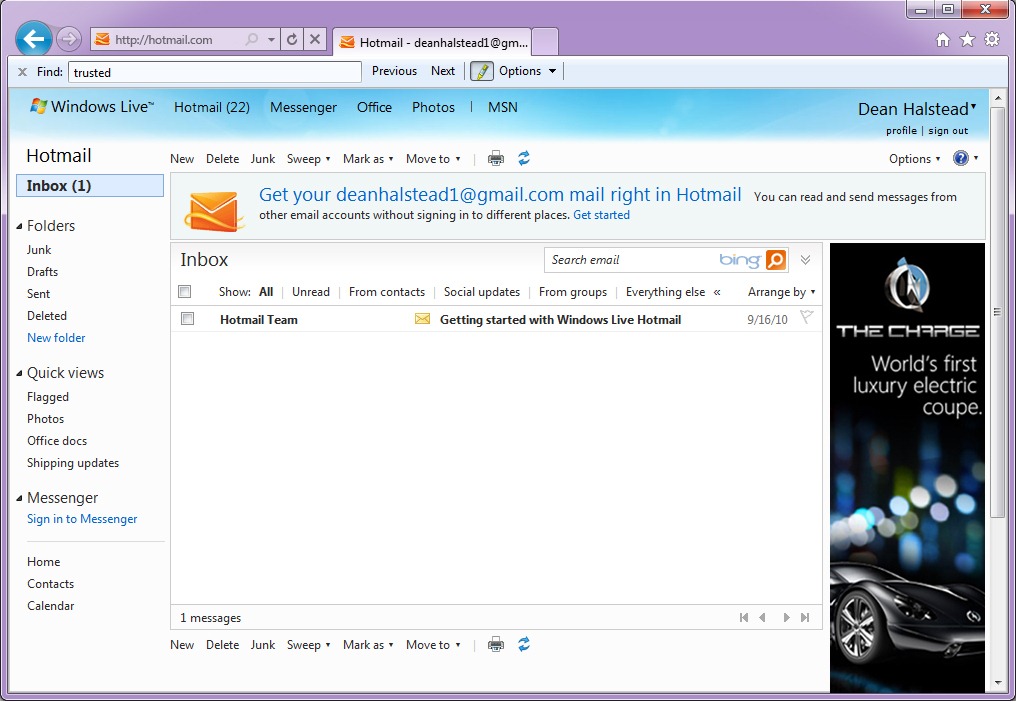
Hotmail switching over to Microsoft Outlook (FAQs)

Microsoft is moving all of its Hotmail users to Outlook.com by this summer. Here's what the hundreds of millions still using Hotmail need to know about the transition.

Microsoft announced earlier this week that it is closing Hotmail and moving the "hundreds of millions" still using it to Outlook.com by this summer.

The move isn't unexpected, but perhaps more sudden than some anticipated. Hotmail users, once they move (or are moved) will get Outlook.com's clean, Metro-Style interface for their mail -- and ultimately, calendars. (For a walk-through of the UI changes Hotmail users will see, check out this Microsoft FAQ.)

Given that many of the new features in Outlook.com -- Microsoft's new Web-mail service that is no longer in "preview," as of this week -- are already part of Hotmail, the Outlook.com experience (beyond the UI itself) shouldn't be too jarringly different.

Microsoft provided guidance last summer for those who wanted to proactively make the Hotmail-to-Outlook.com move. There's not much required on users' parts to make this happen. But some users still have questions. And different folks around the Web have answers.

Q: How much warning do users get before Microsoft move an existing Hotmail account to Outlook.com?
A: There will be several e-mails first prompting people to upgrade on their own.

Q: If I move my Hotmail account to an Outlook.com account, can I change my mind and go back?
A: At this point, no. (When Outlook.com was still in "preview," Microsoft did allow this.)

Q: What happens to all my stored Hotmail once I am moved off Hotmail to Outlook.com?
A: Everything moves over. If you click the upgrade button it takes maybe a few seconds, but all your existing messages auto-populate and carry over.

Q: Which browsers support Outlook.com?
A: Outlook.com is optimized for Internet Explorer 8, 9 and 10; Google Chrome 17 and higher; Firefox 10 and higher; Safari 5.1 on Mac. It also works relatively well on IE 7, Google Chrome 16 and 5; Firefox 9 and 5; Safari 5.1 on Windows and Safari 5 on Windows and Mac. It doesn't work at all on IE 6 and older; Google Chrome 4 and older; Firefox 4 and older; and Safari 4.X and older.

Q: What happens if my Microsoft ID/Windows Live ID is tied to Hotmail? Do I have to get a new one and change my accounts?
A: No. If you use an @hotmail.com, @msn.com or @live.com e-mail address as your Microsoft account, you can keep it, even after Hotmail is shuttered. "Think of this the same way as you would changing your mobile phone carrier. You are simply moving to a better service, but your 'number' (in this case your Microsoft account and email address) stays the same," a Microsoft spokesperson explained.

Q: I already created a separate, new Outlook.com account. So once my existing Hotmail account is moved to Outlook.com, what happens? Will my two Outlook.com accounts be merged?
A: There is no way to actually "merge" these accounts. But you can connect these two accounts and then toggle back and forth by linking them. To do this, go to account settings and select the permissions tab. Click on "manage linked accounts."

Q: Users are being allowed to keep their Hotmail addresses if they want. Wasn’t a big part of creating Outlook.com a plan to get rid of the tired/tainted Hotmail brand?
A: "The simple fact is that many people are attached to their email address. We do expect a certain number to want a new Outlook.com address (which is great); others will want to keep their Hotmail address. Either is fine since they will all get to use the new service," a Microsoft spokesperson confirmed.

Q: When will Microsoft update the calendar in Outlook.com so that it is Metro-Style, instead of Hotmail-Style?
A: Microsoft officials aren't saying anything other than what they've said since summer 2012, which is "soon."

Q: When will Outlook.com be integrated with Skype?
A: Also "soon." No further word from the Softies on the timing.

Read this full story here:  http://www.zdnet.com/microsofts-hotmail-phase-out-whats-a-user-to-do-7000011688/

For more information on anything you have read please contact the IT Support Glasgow experts at Click Networks email info@clicknetworks.co.uk or visit our website http://www.clicknetworks.co.uk

Tuesday, 19 February 2013

Why are online companies moving into TV??

Figures are not out yet for how many people signed up to Netflix in the past week, drawn in by Kevin Spacey's House of Cards drama series, but it marked a significant shift in where we'll find 'must see' TV in the future.

Netflix plan to make at least five new shows a year for their web streaming service and they're not alone.

"I think it will certainly be a very exciting year for online content," notes Director of Amazon Studios, Roy Price.

Price is responsible for making original TV content for Amazon's pay subscription services - Amazon Prime in the US, and Lovefilm in the UK.

"The line between online and 'other' probably starts to become a bit blurred," he admits, adding that Amazon Studios currently has six shows being piloted.

"Right now we have a range," says Price, "we have kids, mostly focusing on pre-school educational content.

"And then on the adult side I would say it is all right now, half hour and comedic in nature."

Microsoft's plans aren't quite as fully formed yet but creating a TV studio in Los Angeles this year is the main objective with original content from all genres being considered.

The programming would sit on Microsoft's Xbox live and use the interactivity that service can offer.
And then there's YouTube, owned by Google.

The online site recently launched its original channels initiative with 20 new channels coming from the UK.

"YouTube gave an advance on future advertising revenue to a few channels," explains Google's Zayna Aston, "to basically help kick start the production of original content on the platform."
'Food Tube'
 
One of those channels is Jamie Oliver's Food Tube which already has 143,000 subscribers, 13 million video views, and it only launched on 21 January 2013.

Whereas Amazon, Microsoft and Netflix own their content, YouTube does not, choosing to concentrate on its proven technology platform instead.

So should traditional TV networks feel threatened by their online competition?

"I think it will be interesting to see how everything evolves with respect to all the different channels and sources of content," muses Amazon's Roy Price.

"And for now all we can do is create the best service we can and certainly to date we co-exist quite amicably with all of our channel and other programming partners."

Traditional TV channels are not being complacent, with audiences increasingly using on demand services such as itv player, 4OD and the BBC's iPlayer.

Victoria Jaye oversees all of the BBC's TV content online and aside from recent statistics that revealed a 177% year-on-year increase in the use of mobiles and tablets to watch shows on iPlayer, there's been another shift.

Jaye says in 2008, 25% of people coming to iPlayer were just browsing.
That's now risen to 42% marking "a change in iPlayer from this catch-up product or utility to a sort of discovery or entertainment experience".

"I think it's really fantastic," reflects Jaye, "that we are seeing the on demand market become creatively competitive with people like Netflix originating content.

"We really want a creative competitive on demand market so for us this is, 'Bring it on!' We're excited."

Please read the full article here: BBC NEWS

For more information on anything you have read, please contact the IT Support Experts at Click Networks in Glasgow. Visit our website: http://www.clicknetworks.co.uk/ 

Monday, 11 February 2013

The end of CAPTCHA?? Gibberish form verification words

It now feels perverse, but about a decade ago, when I first encountered the CAPTCHA system, I found it … satisfying. Even vindicating. I can’t recall what gibberish words I first correctly deciphered, but it was a moment I'd been awaiting since third grade. That year, my teacher summoned my parents to admonish them for my abysmal, no-good, impossible-to-read handwriting. This would be a recurring source of recrimination for me, so it was a redemptive moment when I realized that this skill I'd acquired of reading poorly formed letters, honed over decades, was not only useful, but a defining characteristic of what separated people from machines.

At first, CAPTCHA felt like a simple and agreeable game. You played it quickly, strengthening your bond with the rest of mankind, putting off the day machines will roam the Internet freely, and perhaps come to rule over us in some dystopian Matrix-like future, and went on about whatever mundane task you'd been trying to do—buy concert tickets, post a comment, whatever. It was a pleasant interruption, like a kindly stranger asking you directions before you went on your way.

But like so many things in life, that initial glow faded quickly. Instead of a quick and painless waypoint, the CAPTCHAs got harder in an effort to keep ahead of ever-smarter bots. Solving one no longer recalled the satisfying click of a fastened seat belt, but instead was akin to achieving a perfect seal on a generic imitation of a Ziploc bag. You could do it, but it'd be annoying, and it would take longer than you'd want it to, and even then not work as well as it was meant to.

As the CAPTCHAs were getting harder, I realized I wasn't seeing so well and went to get glasses for the first time. Now, each time I failed one of those tests, en route to registering for a website I didn't really want to have to register for anyway, I was left wondering whether it was the fault of my weakening eyes or the algorithm. I was afraid of being enfeebled while still a young man, left behind by technology, and wondering if the kids in school now could solve these CAPTCHAs easily.
So Wednesday’s news that Ticketmaster is abandoning CAPTCHA feels like a sort of vindication to me. It hasn't just been me. The system is to blame.

If, though, this is progress after a fashion, let's not take it to mean that computers are getting close to passing as human. CAPTCHA set out to be a way for a computer to be able to distinguish between one of its fellows and a person. The Turing test asks whether a human can make that same judgment, which is a very different question.

Ticketmaster customers will now face “phrases, questions or ads” during check-out. One would imagine that asking questions about the world might be a risky proposition, ignorance being rather more widely distributed than one would hope. It's hard to come up with questions that can be reliably answered by any human being that stumbles across a given website. Another CAPTCHA alternative relies on authenticating users’ identities via credentials issued to them by Facebook, Google, Yahoo, and the like. CAPTCHA, for all its frustrations, was a mechanism that allowed for anonymity. You didn't have to prove who you were, merely that you were. The loss of anonymity online brings a whole new set of headaches, more enduring and harder to parse than the transient ones brought about by a struggle with wobbly characters.

But I won't miss trying to tell a 0 from an O, H from 4l, or q from g. It will make a funny story for future generations, that for about a decade at the beginning of the century, we'd agreed as a society that the defining mark of our shared humanity was an ability to read bad handwriting.

Read the full story here:  http://www.slate.com/blogs/

For more information and advice on anything you have read here please contact us or visit our website here: www.clicknetworks.co.uk

Wednesday, 6 February 2013

Click Networks - Cloud Services

View our brand new range of cloud services below and visit our website for more information on how these services can benifit your business and save you money! Click Cloud Services: http://www.clicknetworks.co.uk/Cloud/Cloud.aspx
 

For more information and for what services Click Networks can provide please contact our IT Support Experts today! Tel. 0141 530 9116 or email info@clicknetworks.co.uk

Visit our website: www.clicknetworks.co.uk

Tuesday, 22 January 2013

Web 're-defining' human identity says chief scientist

Social networks such as Facebook and on-line gaming are changing people's view of who they are and their place in the world, according to a report for the government's chief scientist.
The report, published by Prof Sir John Beddington, says that traditional ideas of identity will be less meaningful.

One consequence could be communities becoming less cohesive.
This change could be harnessed to bring positive changes or if ignored could fuel social exclusion, says the study.

"This can be a positive force, exemplified by the solidarity seen in the London 2012 Olympics or a destructive force, for example the 2011 riots," says the report.

"Due to the development of smart phones, social networks and the trend towards (greater) connectivity disparate groups can be more easily mobilised where their interests temporarily coincide."

"For example," it says, "a 'flash mob' can be mobilised between people who have not previously met".

The report, entitled "Future Identities," says that near continuous access to the internet, termed "hyper-connectivity", will drive profound changes to society over the next 10 years.
'Hyper-connectivity' Prof Beddington commissioned the study as part of the Government Office for Science's Foresight programme - the influential Foresight reports look ahead to highlight emerging trends in science and technology with a view to informing policies across government departments.
 
"The most dynamic trend (in determining identity) is hyper-connectivity," Prof Beddington told BBC News.

"The collection and use of data by government and the private sector, the balancing of individual rights and liberties against privacy and security and the issue of how to tackle social exclusion, will be affected by these trends," he said. "I hope the evidence in today's report will contribute to the policy making process."

This latest report on identity undertook 20 separate reviews in which leading UK and international experts assessed research in computer science, criminology and social sciences.

It states that the changing nature of identities will have substantial implications for what is meant by communities and by social integration. The study shows that traditional elements that shape a person's identity, such as their religion, ethnicity, job and age are less important than they once were.
Instead, particularly among younger people, their view of themselves is shaped increasingly by on-line interactions of social networks and on online role playing games.

The study found that far from creating superficial or fantasy identities that some critics suggest, in many cases it allowed people to escape the preconceptions of those immediately around them and find their "true" identity. This is especially true of disabled people who told researchers that online gaming enabled them to socialise on an equal footing with others.

  Social networks also helped people organise during riots in 2011
 
"The internet can allow many people to realise their identities more fully, " the authors write. "Some people who have been shy or lonely or feel less attractive discover they can socialise more successfully and express themselves more freely online".

The report points out that in 2011, 60% of internet users were members of a social network site, a huge surge in usage, up 43% from 2007. Consequently, it says that there may greater political activism using these networks as was seen in the revolution in Tunisia and the mobilisation of dissent in Egypt and Libya.

There will also be a blurring of work and social identities as photos and details of people's personal lives become increasingly public on social networking sites. The report cites a hypothetical example of how a young person was denied promotion because her employer found drunken photos of her from her university days.

The report says that as the distinction between online and real world identities diminishes criminals are likely to try and exploit the many new forms of interlinked data relating people's identities and from social media and professional and financial websites in order to steal identities.

Read the full story here: http://www.bbc.co.uk/news/technology-21084945 or contact the IT Support Specialist at Click Networks with any questions about anything you have read here. Please visit our website: http://www.clicknetworks.co.uk